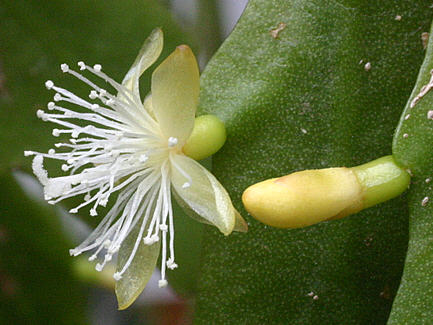
A red-fruited variant or ally of R.
oblonga, from the Serra dos Orgaos (RJ), with
somewhat smaller but thicker stem-segments, is of uncertain
taxonomic position and merits further study. It is sometimes
encountered in cultivation under the inadequately typified
name, R. rhombea (Salm-Dyck)
Pfeiffer.
---------------------------------------------
NEW
See Calvente Thesis 2010
Now treated as a synonym of Rhipsalia cuneata See Ralf Bauer,
EPIG 62: 26. 2008
Rhipsalis occidentalis
Desc from Hunt 2006.
Like R. micrantha but branch segments always flat, up to 6.5cm
diam, green or darkish red; flowers ca 8x10mm
Rhipsalis occidentalis Barthlott & Rauh , Kakteen und
andere Sukkulenten (38) 1. 1987 translated by Luc Scherens
and Derek Butcher.
A new species with leaflike flattened shoots from Ecuador
and Peru
In the variously shaped, large genus Rhipsalis, the species
with flattened, leaf-like shoots were gathered together by
K. Schumann (1899) in a proper subgenus Phyllorhipsalis. The
skilled observer F. Buxbaum acknowledged in 1970 for the first
time, that this is an artificial merging of two groups of
species that are not related : to unite the species with a
basitonic-mesotonic branching and those with often big flowers
with angular pericarp (e;g. Rhipsalis regnellii Lindberg).
Buxbaum revised the subgenus Phyllorhipsalis Schumann emend.
Buxbaum and Phyllarthrorhipsalis Buxbaum became separated
as a new subgenus. This subgenus contains exclusively the
East Brazilian species with acrotonic branching, small white
flowers, naked round pericarp (e.g; R. pachyptera Pfeiffer,
R. rhombea (S-D) Pfeiffer, R. crispata (Haw.)Pfeiffer). This
very characteristic and natural group is limited to East-Brazil
in its geographical description (majority of the species in
the area between Rio de Janeiro and São Paulo).
Consequently, it was very surprising that the authors, during
a common journey in Ecuador and Peru in 1973, collected a
Rhipsalis species that unambiguously belongs to the subgenus
Phyllarthrorhipsalis which was only known from East-Brazil
until then.
A precise analysis of the growth, flowers, pollen, fruit and
seeds has revealed in the meantime that – despite the
strong superficial habitual resemblance – the plant
is not identical to the known Brazilian species and supposedly
not even closely related (probably evolved parallel with the
Rhipsalis micrantha relationship). In this way this new species
shall be described hereafter as Rhipsalis occidentalis. The
name “occidentalis” means “western”
and refers to the isolated occurrence of the species within
a group of species that is only known from eastern South-America.
Rhipsalis occidentalis B & R spec. nov
--------------------------
(latin text)
Description :
Habit : up to 1 m long, overhanging epiphytic plant.
Branching : strongly acrotonic, i.e. young shoots almost exclusively
from the apex of the older shoots.
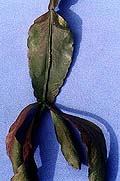
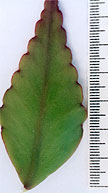
Shoots : up to 6 cm long and 12 cm long, in culture often
only half as big. Leaf-like thin flattened. Margins distinctively
notched. The puny areoles without spines or visible wool in
the notches of the shoots. Epidermis strongly (intensively)
darkgreen, slightly shiny; on new growth often with a brown
overlay.
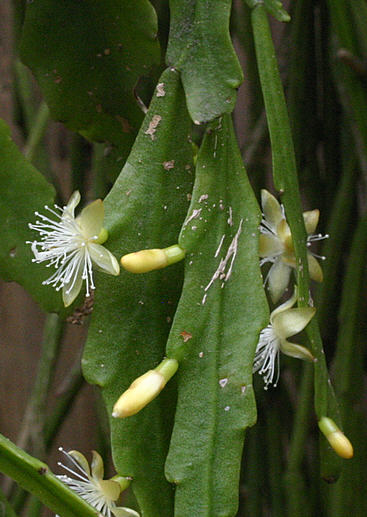
Flowers : single (only occasionally with two) in the areoles,
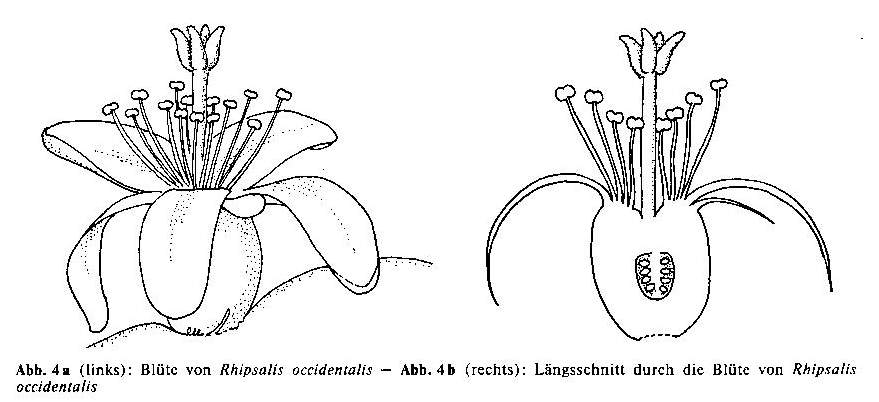
whitish, 10 mm wide and 9 mm long.
Tepals translucent whitish, about 7, up to 4 mm long and 3
mm wide, in full anthesis somewhat bent backwards, the top
bend somewhat hood-like
Stamens : about 50 per flower, whitish, 4-5 mm long, inserted
in a circle . The innermost stamen somewhat shorter than the
outermost ones. Between stamen and style some nectar tissue,
but not forming a clear disk.
Style: whitish, some 6 mm long, with 5-6 erect, strong papilla-like
lobes, whitish. Pollen: 50µm in diameter, 6-colpat,
with very small spinulae and numerous tectal perforations.
Pericarp : cylindrical, greenish white, naked.
Fruit : young fruit at first dirty-brown-red, when ripe a
some 7,5 mm long and 6,5 mm wide dirty-white, juicy berry.
Rich fructification; plant obviously self-fertile.
Seed: some 60 per berry, 1,3 mm long, 0,5 mm wide, pointed
at the apical end. Testa brown-black, border of the elongated
testacells superficially very well recognisable, but –
as with most of the Rhipsalis – without any conspicuous
sculpture. Structure of the seeds reminds of Rhipsalis micrantha.
Habitat : Rain forest of Northeast Peru: Rioja(Dept; San Martin);
altitude 800 m( holotype R & B nr 35392) and near Sucua
(East Ecuador); alt. 950 m (R & B nr 34950). Jens Madsen
(Bot. Inst. Univ. Aarhus, Denmark), within the scope of the
editing of his “Flora of Ecuador”, brought two
gatherings from East-Ecuador to our notice (personal statement).
We can expect with certainty that the species is substantially
wider spread, probably from East-Ecuador along the Andes till
deep in Peruvian territory. Myron Kimnach (Huntington Bot.
Gard. California) brings two gatherings from Bolivia to our
notice (cultivated under HBG 50473 and HBG 53082 : M.K. personal
statement), that are very probably to be assigned to this
species. With this, the total area reaches possibly from southern
Ecuador along the Andes to the Bolivian area.
The relationship and systematic position of the new species
is added next: in vegetative state young plants in culture
are hardly distinguished from the Brazilian species R. rhombea
(S-D)Pfeiffer and R. goebeliana Backeberg. In non-flowering
conditions the difference with R. goebeliana is the dark green
epidermis ( R. goebeliana always noticeably light green);
with R. rhombea the adult plants are distinguished by the
larger shoots and the stronger hanging growth. When flowering
and bearing fruits, the new species is distinguished by several
characteristics : R. rhombea and R. goebeliana are flowering
during winter in our culture (mainly in January), Rhipsalis
occidentalis flowers in early summer (May/June; occasionally
some flowers in February). The flowers are somewhat smaller
and inconspicuous as with the two Brazilian species, they
are purely white (with the two other species in question always
clearly with yellow overlay); furthermore the species is lacking
the reddish nectar tissue, a characteristic of Rhipsalis rhombea.
R. goebeliana and R. rhombea are self-sterile and hardly give
fruits, R. occidentalis is obviously self-fertile and gives
a lot of fruits. While the new species has big, dirty-white
berries, the fruits are smaller than the two Brazilian species,
greenish in R. goebeliana and dirty-carminered in R. rhombea.
Seed and fruit structure raise the suspicion that R. occidentalis
is not closely related to the Brazilian Phyllarthrorhipsalis
at all, but belongs to the Rhipsalis micrantha (HBK) DeCandolle
group. Here it would link the extreme form of a leaf-like
flattened rainforest-epiphyte in a morphological line from
R. kirbergii Barthlott over Rhipsalis micrantha and Rhipsalis
rauhiorum Barthlott. Apparently it concerns a parallel evolution
with the Brazilian species; with that it becomes an additional
example for the systematically confusing, numerous convergences
within the Cactaceae.
The new species, like most Rhipsalideae, is easy to cultivate;
especially when having a rich fructification it is a decorative
enrichment for our collections.
We are much obliged to Myron Kimnach (Huntington Inst. Cal.)
and Jens Madsen (Bot. Inst. Aarhus, Denmark) for the additional
information and to Mr. Thomas Engel (Inst. Syst. Bot. FU.
Berlin) for checking the Latin diagnosis.
Pic 1 : fruiting plant of Rhipsalis occidentalis
Pic 2 : Flowering shoot of R. occidentalis (culture material
from plant shown in fig. 1 and 3)
Pic. 3 : R. occidentalis in habitat near Rioja, North-Peru
(R & B nr 35392). Watch the spreading-hanging growth and
the size of the segments of this adult plant.
Fig. 4 a : Flower of R. occidentalis
Fig 4 b : longtudinal section thru the flower of R. occidentalis;