See Calvente Thesis 2010
8. RHIPSALIS OBLONGA Loefgr., Arch. Jard. Bot. Rio de Janeiro
2:36. 1917.-
TYPE: Loefgren, Arch. Jard. Bot. Rio de Janeiro 2: Tab. VIII. 1918. (lectotype
in Barthlott and Taylor 1995).
Epiphyte in shaded habitat, 2.50 m long, branching apical or lateral.
Stem segments flattened to rarely triangular in longitudinal section,
0.5-0.8 mm diam, olive-green or light green, slightly succulent, monomorphic,
8-15(-16.2) cm long, base attenuate, apex truncate, wings 2(-3\, sometimes
discontinuous (fin-like), 0.5-1.6(-2) cm wide, margin serrate, strong
undulate to plane, with 2-4 mm projections, midrib 1.5-2.5 mm diam, cylindric.
Areoles between margin
projections, 1.4-3.3 cm apart, first of segment 3-5.5 cm distant from
segment base; when sterile 1-2.5 mm diam, with vestigial hairs and scales;
when fertile 1-2.5 mm diam, with 1 acicular scale, scarce marginal hairs,
1 flower/fruit. Flowers not observed. Fruit 5-8 X 5-7 mm, globoid, greenish
translucent (sometimes with pink ring at apex when immature), glabrous.
Figure 6: F.
Notes; Rhipsalis oblonga can be easily identified by the olive or light
green, small and narrow stem segments, with serrate margins, and the large
areoles that may remain active for several bloomings. We here adopt a
narrower circumscription of R. oblonga, following the original circumscription
of Lofgren. Other taxonomic treatments (Barthlott and Tayor 1995; Taylor
& Zappi 2004, Hunt et al. 2006) have adopted a broader circumscription
for R. oblonga and
have also included Rhipsalis elliptica-like specimens with white fruits
under R. oblonga. However, several morphological traits (as the areoles,
flowers and stem morphology) indicate that those individuals are better
placed under R. elliptica and R. crispimarginata. Furthermore, the inclusion
of all white fruited Rhipsalis elliptica-like specimens under R. oblonga
would lead to the recognition of a polyphyletic R. oblonga (Calvente et
al. in prep; Fig. 1). Therefore, some
specimens previously included in R. oblonga are now placed in R. crispimarginata,
R. elliptica subsp. elliptica and R. elliptica subsp. microflora. Even
though flowers of R. oblonga were not observed in the field or in the
herbarium, these flowers were previously described as having 3-4 sepaloid
tepals and 5 petaloid tepals, up to 8 mm, reflexed, yellowish with reddish
apex,
numerous whitish stamens and style with 4 lobes (Loefgren 1917).
Habitat and distribution: Occurs in Rio de Janeiro and northern Sao Paulo in coastal or montane Atlantic Forest. Figure 3.
Rhipsalis oblonga Lofgren, Arch. Jard. Bot. Rio de Janeiro 2: 36. 1918.
Desc from B&R 1923
Plant - in cultivation bushy; main branches terete below, more or less
flattened above;
ultimate branches narrowly oblong, 5 to 15 cm. long, 1 to 2 cm. broad,
shining green even
in sunlight;
Flowers - borne along the sides of the branches, solitary at the areoles;
Fruit - globular to short-oblong, 3 to 4 mm. long, nearly white, naked,
crowned by the
withered perianth.
Type locality: On Ilha Grande, Brazil.
Notes from Bradleya 13
DISTRIBUTION. Brazil (S Bahia, Espirito Santo?, Rio de Janeiro, Sao Paulo):
epiphytic and epilith¬ic in perhumid Atlantic forest, near sea level
to c.1300 m altitude.
This taxon has the thinnest stem-segments amongst the Brazilian species
and is very closely related to R. crispata, but appears to be rare in
cultivation, where it needs some shade and high humidity to succeed. As
to type, R. crispimar¬ginata Lofgren (1918) is a synonym of R. oblon-ga,
as has been confirmed by field studies at the type locality they share,
but in cultivation this name is commonly misapplied to R. crispata (Haworth)
Pfeiffer.
R. oblonga is also very similar to R. goebe¬liana from Bolivia and
to R. occidentalis from northern Peru, southern Ecuador and Suriname.
They differ from R. oblonga in their stem-segments being consistently
narrowly cuneate at base, the pericarpel of R. goebeliana being more elongate
and the flowers of R. occi¬dentalis generally smaller than those of
the Brazilian species.
A red-fruited variant or ally of R. oblonga, from the Serra dos Orgaos
(RJ), with somewhat smaller but thicker stem-segments, is of uncer¬tain
taxonomic position and merits further study. It is sometimes encountered
in cultivation under the inadequately typified name, R. rhombea (Salm-Dyck)
Pfeiffer.
Desc from Hunt 2006.
Body pendent up to 1m or more, dark to pale or yellow green, rarely tinged
reddish, freely emitting aerial roots; basal shoots up to 20 x 2 cm; branch
segments flattened (rarely 3 winged), but margins often undulating, crenate,
up to 12(-23) x 2-6 (-7)cm, ca1mm thick away from midrib, cuneate to truncate
at base; areoles in the crenations 2-4mm from branch segment margin, woolly
and sometimes bearing 1 or more small bristly spines; flowers 1-2 per
areole, 1.5 x 1.8cm; interior tepals 5, greenish yellow; stigma (3-) 4-5,
up to 3mm; fruit 6-7 x 7-8mm, white or pale pink at apex.
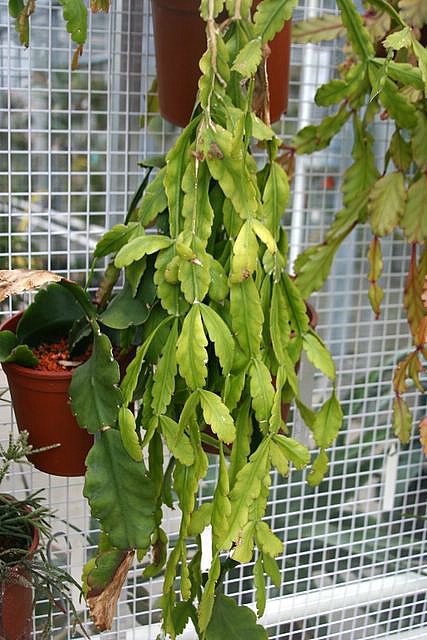
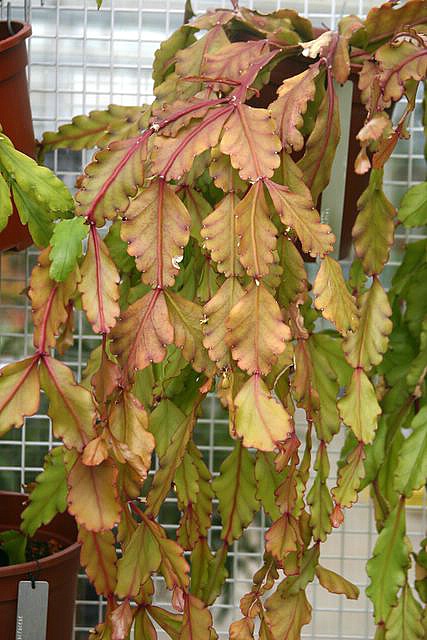
Two photos of R. oblonga (copyright KAF, Kew 2006)
 Rhipsalis
oblonga
Rhipsalis
oblonga
Archivos do Jardim Botanico do Rio De Janeiro, Vol II,
1918
 Rhipsalis crispimarginata
Archivos do Jardim Botanico do Rio De Janeiro, Vol II, 1918