| Rhipsalis
trigona
Pfeiffer, Enum. Cact. 133.
(1837) |
||||
|
|
Desc from B&R 1923 Plant
- stems stout, very much branched, 1.5 cm. in diameter, strongly 3-angled,
the anglesor ribs alternating with those of adjoining joints; Notes from Bradleya 13. DISTRIBUTION. Brazil (S Sao Paulo, Parana, E Santa Catarina): epiphyte in seasonal Atlantic forest, to c. 800 m altitude.
|
|||
| This
name is neotypified here so as to maintain the usage established
more than a century ago by Schumann (l.c.), Lindberg (l.c.) et al.
and followed by nearly all later authors. It may be doubted, however,
that Pfeiffer's plant was the same, since his description requires 'Areolae
2-4 lin. [c. 4-8 mm] distantes', which can scarcely apply to the plant
we know today and suggests that he may have been describing a form of
Lepismium cruciforme ('Num forsan Lepismii species?', Pfeiffer,
l.c.). If the present solution is not acceptable (e.g. because it may
be argued that the neotype is in serious conflict with the protologue),
then the name will need to be conserved with a new type, or the
species redescribed since there appears to be no other validly published
name for it.
Glaziou
(in Mem. Soc. bot. France 1(3): 327. (1909) reports R. trigona from
Rio de Janeiro (Serra dos Orgaos) and Lombardi (1993: 73) expands its
range further to include Espirito Santo. However, neither of these reports
appear to be supported by specimens and on present knowledge the species
does not appear to range further east than the region of the city of
Sao Paulo. |
||||
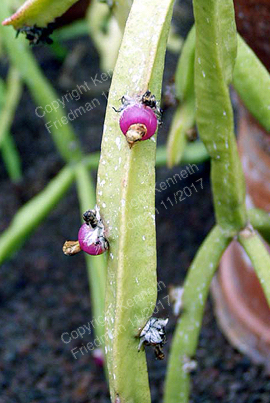 Photo from the Brussels Botanic Garden,