Rhipsalis pilocarpa Lofgren in Monatsschr. Kakteenkunde 13; 52 (Apr. 1903) and in Revista Centr. Sci. (Campinas) 1903 (4); 188 (July 1903)
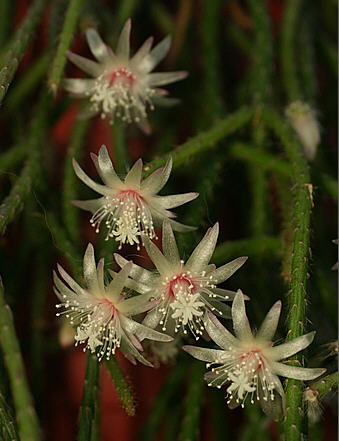
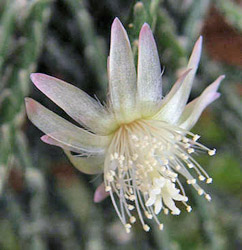
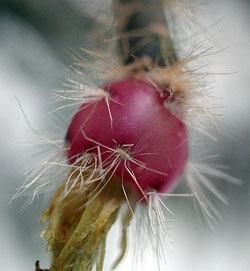
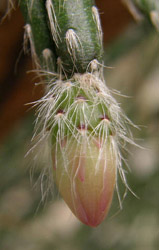
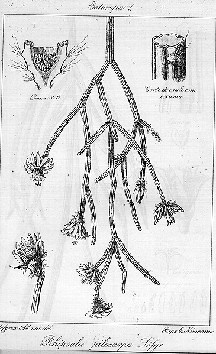
Desc from Hunt 2006.
Branches slender cylindric; branch segments up to 40x6mm, branching
verticillately at the apex; areoles green, often tinged purple, numerous;
spines 3-10, 4-6mm, setacious, white; flowers terminal or apical, solitary
or paired, 2.5-4cm diam, white; pericarp bristly; fruit globose, up
to 12mm diam, wine red, bristly
Originally this
was Erythrorhipsalis pilocarpa (Lofgren), the only species of
its kind in its own group. The only visual resemblance it has to other
tubular Rhipsalis is its pencil-type growth. Otherwise it is
easy to identify because its stems are covered with fine white hairs
growing from the areoles. In sunlight the stems can become tinged red.
Flowers are slender and bell-like but open widely, appear at the ends
of the stems so on the longer stems they will hang downward. The branches
often end in three to six smaller branches, which when in flower make
the plant look like an upside-down starburst. Fruits are red to maroon
and have tiny hairs on them. From Rio de Janeiro and Sao Paulo.
Desc from B&R 1923
Plant
- stems dark green to purple, at first erect, sometimes 4 dm. long and
unbranched, terminated by 2 to 4 branches in a whorl, the ultimate branches
often only 1 cm. long, in time the whole plant becoming pendent;
Joints
-
clustered,
when withering somewhat angled, tipped by yellow bristles;
Areoles
-
filled
with long setose hairs or bristles subtended by ovate scarious bracts;
Flowers
-
at
ends of terminal branches, very fragrant, opening slowly, up to 2
cm.
broad;
Flower-tube
-
2
mm. long, reddish on the inside;
Outer perianth-segments
- 5 or 6, triangular, rose-colored;
Inner perianth-segments
-
10 to 15,
spreading
or sometimes recurved, lanceolate, acuminate,
10 mm. long, white or cream-colored with pinkish tips;
Stamens
-
numerous, red at bases;
Ovary -
with several areoles, bearing as many as 10 bristles, subtended
by small scarious scales and surrounded by purple spots;
Style - exserted
in the bud; stigma-lobes 4 to 8, white, spreading apart the second day
after the appearance of
the style and before the stamens appear.
Type Locality; Ytu and Ypanema,
Sao Paulo, Brazil.
Notes from Bradleya 13
DISTRIBUTION. Brazil (S Minas Gerais, S Espirito Santo, NW Rio de Janeiro, S Sao Paulo, E Parana): epiphyte in seasonal forest, at C. 500-900 m altitude. A specimen derived from Lofgren's type (fide N.E. Brown), but preserved only in 1904, is at Kew (K!).This species appears to be rare, being known at present from only 7, mostly isolated localities. It is rather variable in habit and especially in its flowers, and at least four distinct variants are known in cultivation. If these should correspond to geographically discrete naturally occurring races, it may be necessary to describe them as subspecies.